How
do you herd fish?
Like
cats, only in three dimensions!
The Physical
Fish Herding Project
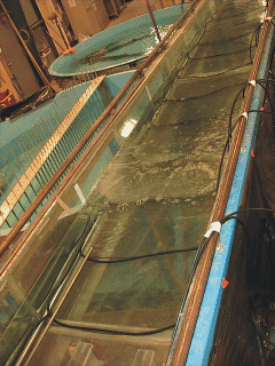 If
fish could be herded, it would help in their farming, capture, and enhancement.
This research addresses fish herding for the purpose of getting fish up
past dams, so that fish populations might survive. The only natural models
of fish herding available are of humpback whales and porpoises. The whales
surround fish with an air bubble curtains that concentrate the fish into
one small area, then the whales surface through the school middle with
their mouths open and eat well. If
fish could be herded, it would help in their farming, capture, and enhancement.
This research addresses fish herding for the purpose of getting fish up
past dams, so that fish populations might survive. The only natural models
of fish herding available are of humpback whales and porpoises. The whales
surround fish with an air bubble curtains that concentrate the fish into
one small area, then the whales surface through the school middle with
their mouths open and eat well.
Our research follows this whale
design school of thought. We have observed in our research with trout,
salmon, hitch and other fish that that fish not only shy away from bubble
curtains as in the anchovy from the whale, but in many other cases fish
both individuals and schools are attracted to the bubbles for cover, play,
and curiosity. We are using all these modes of interaction along with
multiple moving air curtains to herd the fish.
Currently,
the Intellectual Property for this idea is Patent Pending.
The Olfactory
Fish
Herding Project
Fish respond to scent. Different
scents excite different fish in different ways at different times. This
research project looks at a range of scents and a range of ways that scents
can be used to assist fish search for a return path to their natal grounds
for mating and reproduction.
The research targets upstream
bound anadromous fish in particular and addresses the very important question
of how they can they be assisted upstream past dams where they are both
attracted to a dead-end large flows from a turbine and to a smaller fish
bypass flow. The small flow is often inadequate to attract fish, and this
project looks at how can scents be used to speed their entrance to a fish
bypass facility.
|